

The history of the Cowell-Purisima Trail stretches back thousands of years, from the Ramaytush Ohlone village of Ssaliame to the ranches and conservation efforts that shaped the coast we know today. Before you hit the trail, take a moment to explore the stories that shape this landscape.
Every time I cross Highway 92 into Half Moon Bay, I’m reminded how special this stretch of coast is. There’s the unparalleled beauty of the Pacific Ocean, of course. But there are also more than 45 miles of coastline without a single traffic light between Half Moon Bay and Santa Cruz (and many incredible trails to pull over and explore). Here at POST, one of our longtime favorites is the Cowell-Purisima Trail.
This July marks 15 years since the trail opened to the public, inviting visitors to explore 3.6 miles of bluff-top coastline with sweeping ocean views, sandy beaches, and working farmland. But the scenery is only part of the story. The landscape along the trail holds thousands of years of history, from the Ramaytush Ohlone village of Ssaliame to the region’s ranching heritage and the conservation efforts that made this public trail possible.
If you’re eager to hit the trail, you can find hiking information via the button above. But before you go, take a moment to explore the stories woven into this landscape and discover what makes the Cowell-Purisima Trail so much more than a beautiful coastal walk.
Ssaliame: A Ramaytush Ohlone Village

Roughly midway through, the trail crosses Purisima Creek. Just north of the stream stood Ssaliame, a village of the Cotegen tribelet of the Ramaytush Ohlone people. For thousands of years, this was home. The Cotegen people stewarded the lands and waters of the Purisima Creek and Tunitas Creek watersheds, building their lives around the abundant resources of the coast and creek.
While no visible traces of Ssaliame remain today, descriptions of the village and its people survive in journals from the Portolá Expedition.
One of Ssaliame’s notable descendants was Pedro Alcántara, who was born here in 1786. As European colonization endangered Indigenous communities, much of the Ramaytush language was lost. Alcántara helped preserve part of that legacy by recording the only known list of words from the Ramaytush language.
In the early 1850s, reflecting on the devastating changes he had witnessed, Alcántara said:
“My people were once around me like the sands of the shore. I am all that is left of my people—I am alone.”
While Alcántara mourned the losses his community had experienced, Ramaytush Ohlone lineages survived. Today, descendants of the original peoples of the San Francisco Peninsula continue to maintain cultural connections to their ancestral homelands.
This is a powerful place to reflect on the deep history of this landscape and the generations who have cared for it. Standing here, it’s easy to see why Ssaliame thrived: fresh water flowed nearby, and the rich resources of the Pacific coast lay just beyond.
Purissima: The Rise and Fall of a Coastal Boom Town
If you were to follow Purisima Creek upstream from where it crosses the Cowell-Purisima Trail, in less than a mile you’d find the ghost town of Purissima (double “s”). You might be surprised to hear that at one point in time, this town was one of the most prosperous communities on the San Mateo Coast.
Founded in 1868 by Henry Dobbel, a German immigrant who had made a fortune in San Francisco during the Gold Rush through trade and a successful waffle restaurant (yum!), Purissima was one of the first Euro-American settlements on the coast. Dobbel financed much of the town’s initial construction and, by the early 1870s, the town boasted a post office, hotel, several stores and a school with over seventy students enrolled.
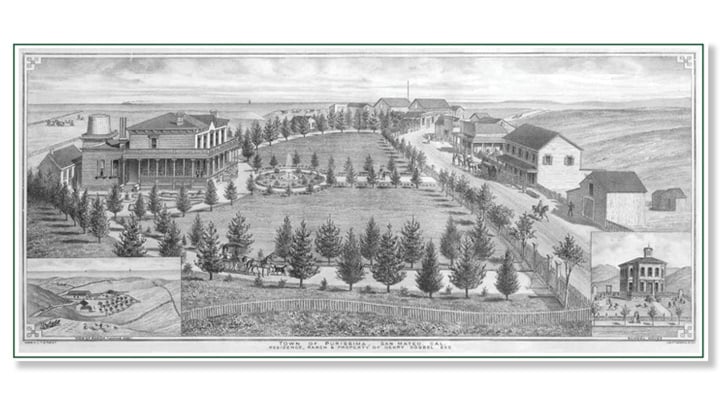
The future looked promising for this burgeoning coastal town, and when the Ocean Shore Railroad arrived in the early 20th century, suburban expansion along the coast south from San Francisco became a real possibility. But years of crop failure and a decline in local logging drove most residents to the more established Spanishtown (now known as “Half Moon Bay”). And when the railroad went bankrupt in 1920, it wasn’t long until the town of Purissma was completely abandoned. Today, there are no standing structures, but the cemetery is still visible along Verde Road. It’s worth driving past on your way to or from the Cowell-Purisima trailheads.
How Henry Cowell’s Coastal Ranch Became a Trail
 You may be wondering about the word Cowell in the trail’s name. Turns out it’s in homage to Henry Cowell, a powerful business tycoon from the second half of the 19th century. He made a fortune in the lime kilns business, supplying San Francisco with much needed building materials. Today there are still a number of locales with his signature, including Henry Cowell Redwoods State Park, Cowell Beach and Cowell College, to name a few.
Aside from his business exploits, Henry Cowell was also a very wealthy land owner. In the late 19th century, he bought the ranch the Cowell-Purisima Trail now crosses with the intention of raising exotic breeds of cattle, horses, and angora goats. After his death in 1903, the land was passed down through the generations and eventually put on the market in 1985 to raise funds for the Cowell Family Foundation.
Protected for You…Forever
When the Cowell Foundation decided to sell the ranch in 1985, the land was at risk of being lost forever to urban development. POST, not even a decade old at that time, had to act quickly to acquire and protect this land from that threat.
The Cowell Foundation offered POST one year to raise $2 million to acquire the property. Through the support of generous donors, POST was able to leverage private contributions to obtain a matching grant from the Cowell Foundation and, with the help of state bond funds, protect this piece of the San Mateo Coast. It was one of POST’s earliest milestones in protecting this part of our coastline.
After permanently protecting the ranch through a conservation easement, POST sold nearly 1,200 acres to local farming families for row crop agriculture and cattle grazing. The remaining land, all immediately adjacent to the coast, was donated to the State of California. It is through this work that the Cowell-Purisma Trail became a reality for you to explore.
Part of a Grand Coastal Vision
The trail is also part of the California Coastal Trail, an ambitious network that will one day connect the entire California coastline from Mexico to Oregon. Today, about 70% of the trail is complete, linking together beaches, bluff-top paths, bike routes and other coastal experiences across the state. Here on the San Mateo Coast, POST is working with partners to help close key gaps in the trail, creating more opportunities for people to safely access and enjoy the coast while protecting the landscapes that make it so special.
The Cowell-Purisima Trail is a reminder that conservation is about more than protecting land. It’s about protecting the stories, connections and experiences that make a place meaningful. Fifteen years after opening to the public, this beloved trail continues to invite people to discover the coast—not just as it is today, but as it has been for generations and as we hope it will remain for generations to come.
Preview the Trail
Virtual tour created by Outdoor360Tours
Related Posts
About Post
Peninsula Open Space Trust (POST) protects open space on the Peninsula and in the South Bay for the benefit of all. Since its founding in 1977, POST has been responsible for saving more than 97,000 acres as permanently protected land in San Mateo, Santa Clara and Santa Cruz counties. Learn more
